
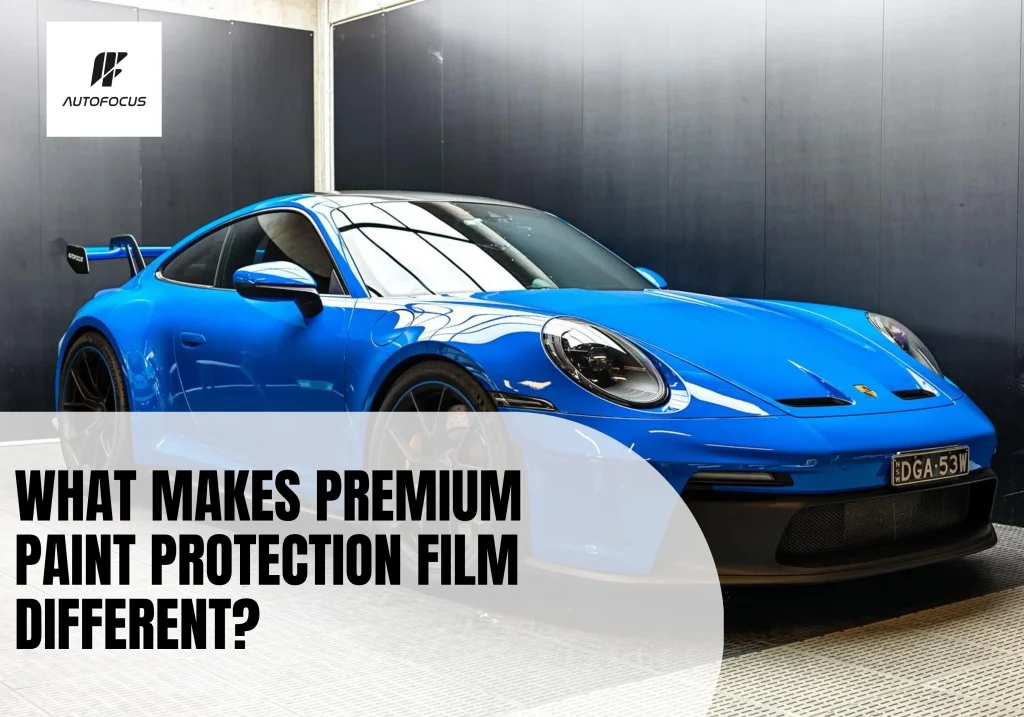
Not all paint protection film is the same. There is a budget version that does the job in theory—and a premium version built to last. Know the difference first. Premium paint protection film is a multi-layer thermoplastic urethane film built to take the hits your paint can’t. Premium paint protection film is a multi-layer thermoplastic urethane film built to take the hits your paint can’t. If you’re still deciding whether PPF is the right solution, our guide on vinyl wraps vs PPF for car protection should be your first comparison. Self-healing technology, UV resistance, and optical clarity aren’t selling points — they’re the baseline for anything worth putting on a serious car.
This covers:
- What separates premium PPF from basic alternatives
- The key features that make it worth the investment
- Why Australian conditions make premium protection especially critical
- What it costs and how to find the right installer
What Is Premium Paint Protection Film?
PPF started life in the military — originally used to protect helicopter rotor blades from debris damage in Vietnam. The automotive version that followed was functional but limited.
It was prone to yellowing, difficult to install cleanly, and not exactly invisible once it aged.
Modern premium paint protection film is a different product entirely. The construction runs through four distinct layers: a polyester release liner, a pressure-sensitive adhesive, a thermoplastic urethane base, and a clear top coat.
Each layer does a specific job. Where budget films cut corners, premium films don’t — and the difference shows up over time, not on day one.
Budget films run thinner, bond less evenly, and start lifting at the edges well before their time is up. They also lack the topcoat chemistry needed for genuine self-healing.
A premium film — from brands like STEK or SunTek — is engineered to stay clear, stay flexible, and stay adhered through years of real-world exposure. This is particularly important when considering how paint protection film performs in Sydney’s heat, where prolonged UV exposure can accelerate the failure of lower-quality products.
The Features That Set Premium Paint Protection Film Apart
The gap between standard and premium PPF is not just marketing. The next two sections break down the technology that actually makes the difference — no vague claims, just a clear look at what a quality film can do.
Self-Healing Technology and UV Resistance
One of the most compelling aspects of premium PPF is its self-healing topcoat. This layer is made from an elastomeric polymer that returns to its original shape after surface-level scratches.
The recovery is typically activated by heat — sunlight or warm water. Light swirl marks and minor abrasions that would otherwise dull the finish simply disappear.
UV resistance is equally important. Polymer-based surface coatings work through a continuous molecular film that holds up under environmental stress, resisting chemical attack and exterior weathering across years of exposure.
In paint protection film, that chemistry means the topcoat holds its clarity. No yellowing, no degradation, even after years of direct Australian sun. Basic films often lack the stabiliser chemistry needed to hold optical clarity over time.
That is why older budget installations sometimes take on a faint amber tinge after a few Australian summers. Premium film is formulated specifically to prevent that. If you’re concerned about long-term film appearance, it’s also worth understanding the common causes of PPF yellowing and how to prevent it.
Why Clarity, Water Resistance, and Durability All Come Down to the Adhesive
A well-installed premium film should be essentially invisible. The optical clarity of top-tier PPF comes from consistent film thickness, precise layer bonding, and a clear coat that refracts light cleanly.
A properly installed film adds nothing visually — except that the paint somehow looks better for it. Vehicle owners looking for maximum gloss often pair their film with a professional graphene coating to further enhance hydrophobic performance.
The hydrophobic topcoat means water sheets off cleanly rather than pooling and leaving mineral deposits behind. This reduces water spotting and mineral deposits, particularly relevant in Sydney’s coastal environment.
Long-term durability lives or dies with the adhesive. Cheaper formulations lift at the edges when heat and humidity push them past their limits.
Premium adhesives bond flat, handle temperature swings without protest, and release cleanly at the end of life. No residue, no lifted clear coat, no nasty surprises at trade-in.
Why Australian Drivers Need Premium PPF More Than Most
Australia runs its cars hard. The UV index in Sydney regularly hits extreme levels (far above what most European or North American drivers encounter), and the road network adds its own risks.
Vehicle damage can arise from the condition of state-controlled roads, roadworks, bridges, and other infrastructure managed by transport authorities. Not all claims for debris damage are accepted under standard maintenance liability provisions.
In plain terms, if road debris damages your paint on a NSW road, the chance of recovering that cost through an official claim is low. The risk sits with the driver.
This is precisely where PPF earns its place. High-quality PPF absorbs repeated low-level impacts that accumulate invisibly over time — micro-chips, grit, gravel flicked up on the motorway.
Without protection, each of those impacts chips away at both the paint and the resale value of the vehicle. This is especially true for darker paint colours, which tend to show chips and swirl marks more readily. That’s one reason why paint protection film is ideal for black cars.
The resale dimension matters more in the Australian market than many buyers initially realise. Used car values here are sensitive to paintwork condition.
A vehicle protected from new by premium PPF — with chip-free, well-maintained paint — commands a noticeably stronger position at trade-in or private sale.
Where and How to Apply Premium PPF on Your Vehicle
Coverage comes down to three things: how the car gets used, which panels take the most punishment, and what the budget allows.
The front bumper, bonnet, guards, door edges, and door cups absorb the majority of stone chips and daily contact damage. These catch the bulk of stone chips and abrasion from opening doors in tight car parks.
A partial front-end package covering these zones offers solid protection at a more accessible entry point.
Full vehicle coverage makes sense for new or near-new vehicles, high-value cars, or anyone who wants comprehensive paint preservation. It provides consistent protection across every panel. No gaps, no compromises.
As for finding the right installer, application quality is as important as film quality. PPF cut and applied poorly will lift at the edges, trap dirt, and look ordinary.
Look for an installer with a verifiable track record on vehicles similar to yours, who uses pattern-cut software and can clearly explain the products they use. A shop that hedges on brand names or warranty terms is worth walking away from.
Premium Paint Protection Film FAQs
The questions that come up most often before a booking tend to be the same ones. Cost, lifespan, what pairs well with PPF, and whether it makes sense outside of a prestige garage — covered below.
How much does premium PPF cost in Australia?
Entry-level partial coverage typically starts in the low to mid hundreds. A full vehicle package from a reputable installer using premium film will sit considerably higher.
The range reflects film quality, vehicle size, panel complexity, and installer expertise. Getting at least two or three quotes from established shops gives a realistic picture. For a more detailed pricing breakdown, see our guide on the cost of paint protection film in Sydney.
Is premium PPF worth it for everyday cars, not just luxury vehicles?
Genuinely, yes. In fact, many owners of pre-owned vehicles ask whether paint protection film is worth it on used cars, especially when the paint is still in excellent condition. The logic is the same regardless of badge: a car with undamaged paint is worth more and costs less to maintain than one with chips and clear coat deterioration.
PPF pays back at resale, reduces detailing costs, and removes a lot of low-level anxiety about where to park.
It’s Been Ten Years On. What Happens to the Film and the Paint Underneath?
Most premium-grade films carry a ten to twelve-year warranty, varying by brand and product tier. A quality film installed correctly can often exceed that in practice.
Removal is clean when the film is within its service life. The adhesive releases without pulling up the clear coat or leaving ghosting behind. Films left past their lifespan or installed poorly are more likely to cause issues on removal.
PPF or Ceramic Coating — Do You Actually Need Both?
They solve different problems, which is why the question of one versus the other mostly misses the point. PPF provides physical impact protection; ceramic coating adds a hardened, hydrophobic surface layer that makes cleaning easier and enhances gloss.
Many installers — including Autofocus Solution — apply a ceramic coating over PPF to combine both benefits. It is the most complete setup.
Every Day Without Premium Protection Is a Day Your Paint Is at Risk
Stone chips do not schedule themselves. The damage that matters most tends to happen on ordinary days — the freeway commute, the car park that was a little tighter than expected.
If you’ve recently purchased a new or near-new vehicle and you’re still deciding whether premium paint protection film is the right move, the consultation is the right starting point.
Autofocus Solution offers obligation-free advice, works with premium brands including STEK and SunTek, and applies every film with the precision that makes it invisible — in the best possible way.
Book a no-obligation consultation with Autofocus Solution here. It takes less time than your next detail, and the protection lasts considerably longer.